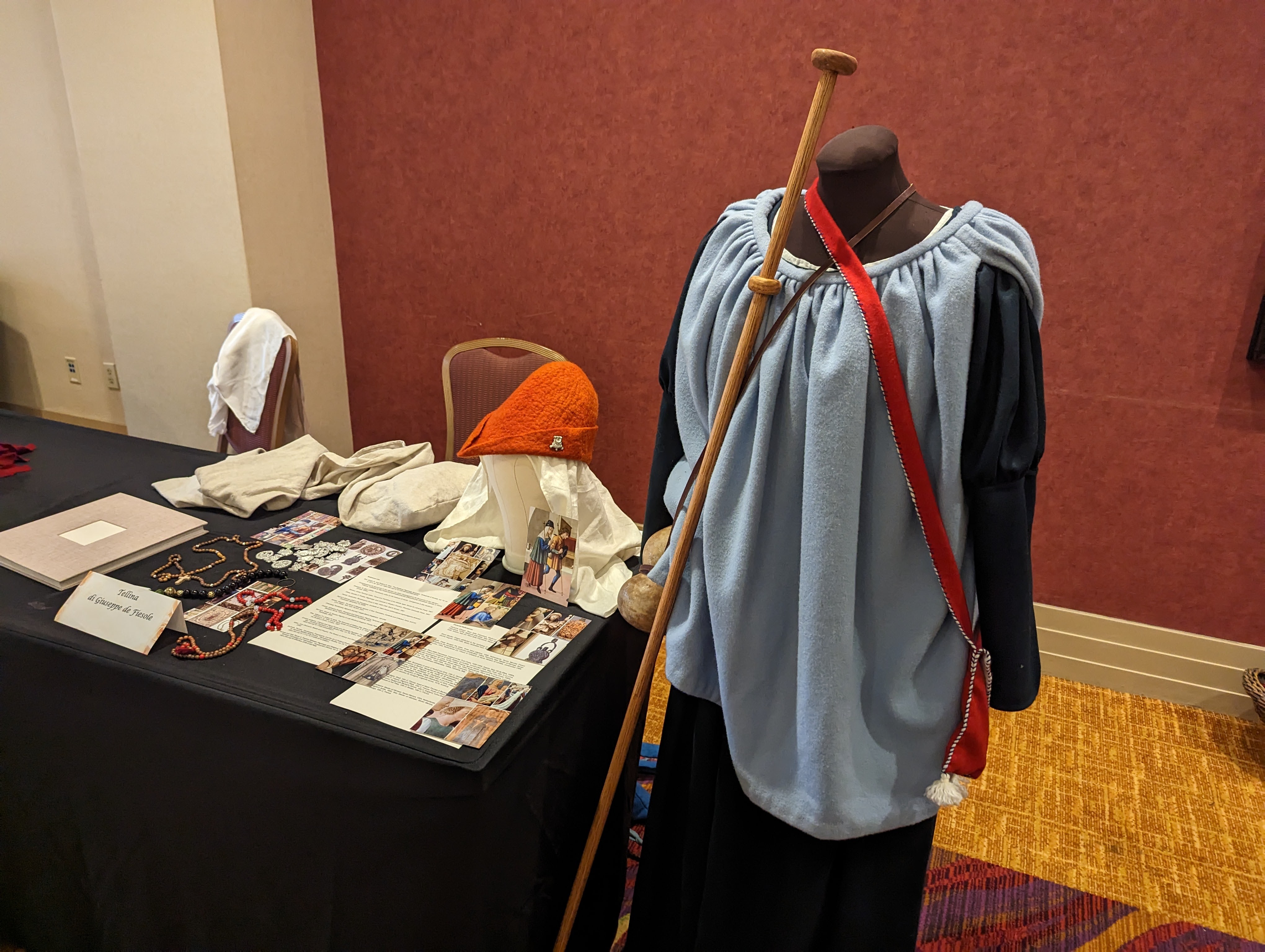
Update: I decided to revisit the topic of pilgrimage for my 2023 12th Night Display. I created a new gamurra in a lighter wool, new scipt (bag), gourd water bottle and staff, as well a selection of possible paternoster/ rosaries for my target 1460s-1470s date.
A quick look at the display: Video
I did a lot more research to have context for the material culture and be more conversational on many topics surrounding religious travel in the period. Resources used for the display can be found here: Reference List
View more detail on my original pilgrim project at https://sites.google.com/westkingdom.org/tellina-apotheca-2022/home


Chemise
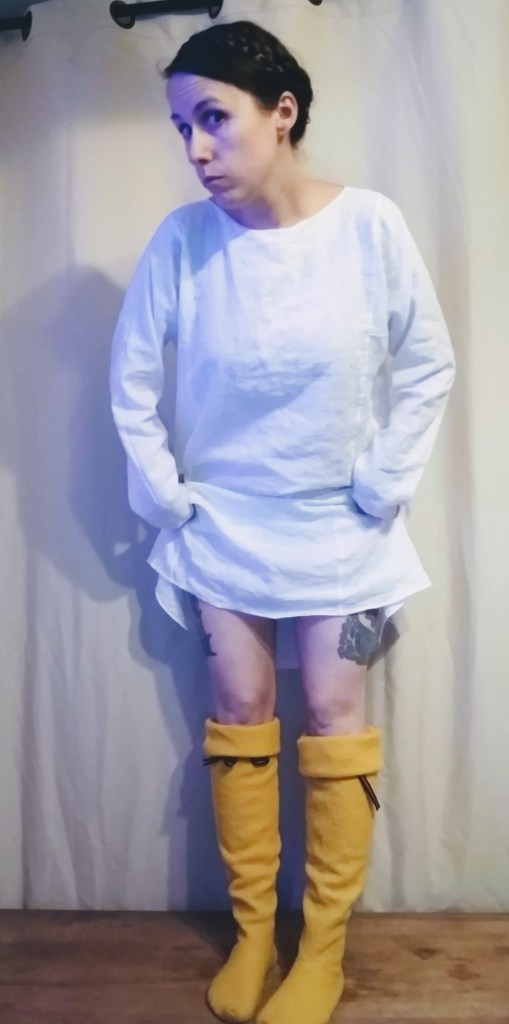
There is ample evidence for feminine dress in the mid-15th century dress including a base layer chemise or “camisa” in Italian. There are glimpses of this garment in most paintings, but there are very few images to base construction on. Chemise were generally made of linen although sometimes silk or cotton (Herald, 212). I’ve chosen a linen for my chemise as it seems to be the most common. The bits of visible chemise in my target era do not seem to have the billowy proportions of later chemise, so I went with an economical cut. Looking at both earlier and later evidence it seemed reasonable to use rectangular construction. The chemise was all hand sewn and you can see it cut my cuffs just a tad too tight to roll up so I did some of that terrible period piecing.
Stockings
Women’s stockings, or “calze” in Italian, are an even greater mystery! While men’s hosen are depicted in a sort of partial dress, a bit of toe is generally the most you see of ladies’ socks. Stockings were usually made of woolen cloth and were often, but not always, worn with shoes (Herald, 211). There seem to be few indicators how tall women’s stockings were or how they were held up during the 15th century. With so little to go on, I based my construction on a 15th century German drawing. The decision to make them yellow was entirely fanciful, I’ve most commonly seen stockings depicted as red on women, although all colors appear on men.
Foundation
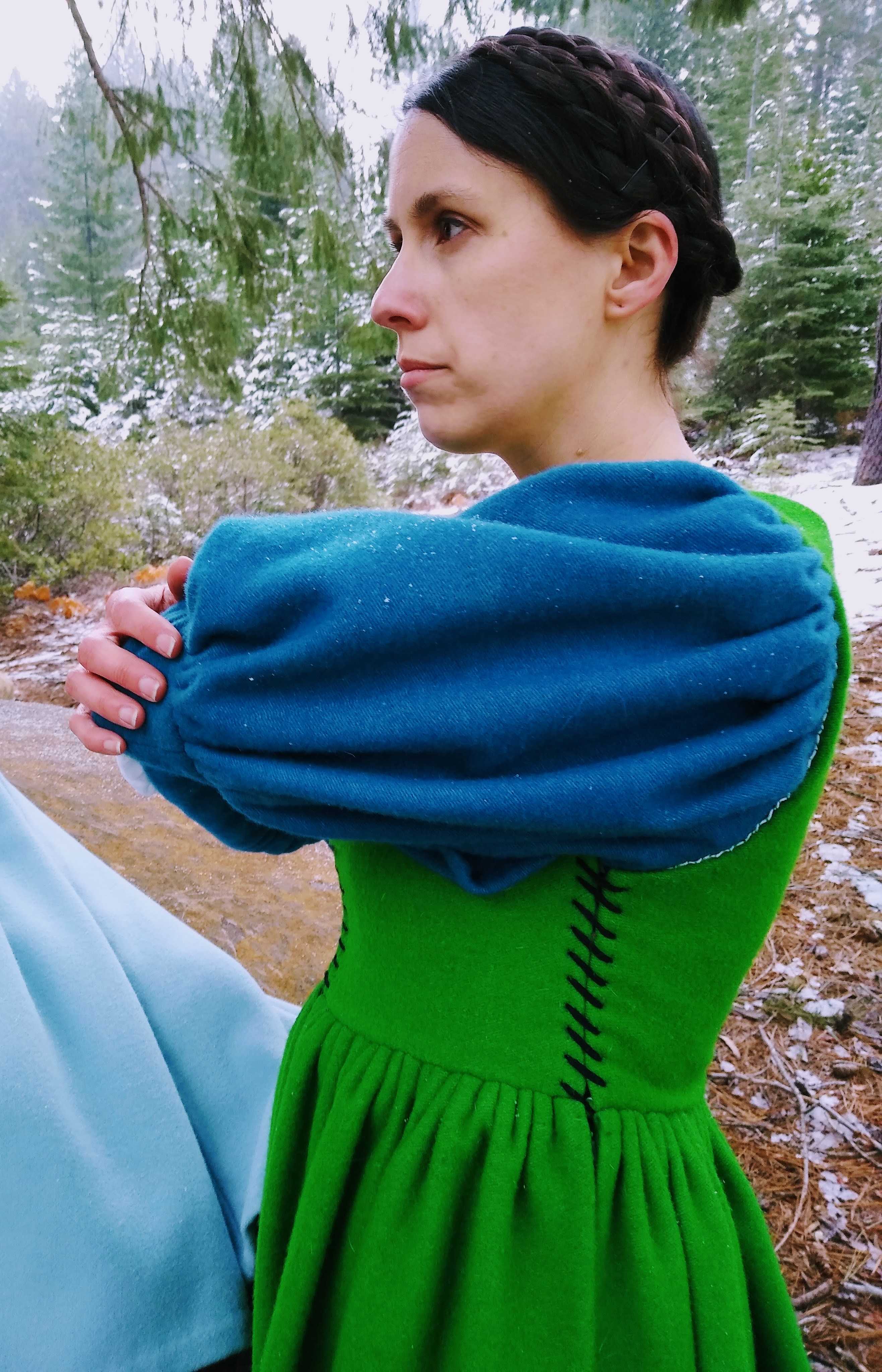
The simple dress or “gamurra” in Italian is a foundational garment as well as being the informal garment worn in the home (Hearld, 216). There are no known extant dresses from my exact time and place, so construction details such as seam placement are based on paintings rather than later pieces. For my gamurra, I’ve opted for green wool. The material is on the heavy side for this application, but sometimes you have to work with what you’ve got. Hearld notes that gamurre may be unlined, however the wool gamurra of Osanna Andreasi which is the closest extant piece I’ve found is lined with linen in the bodice only which seems to give a more supportive garment. While my inspiration dress is from the 1480s, I went for the earlier puff sleeve to date myself back towards that 1460s target date. I included side and front lacing based on the Piero della Francesca’s Madonna del Prato, as well as other paintings. Typically during this era lacing is closed unless there is significance to it being open (such as depicting pregnancy), down side is I lost some weight between patterning and taking final pictures, so the gamurra wasn’t as supportive as it had originally been.
Warmth
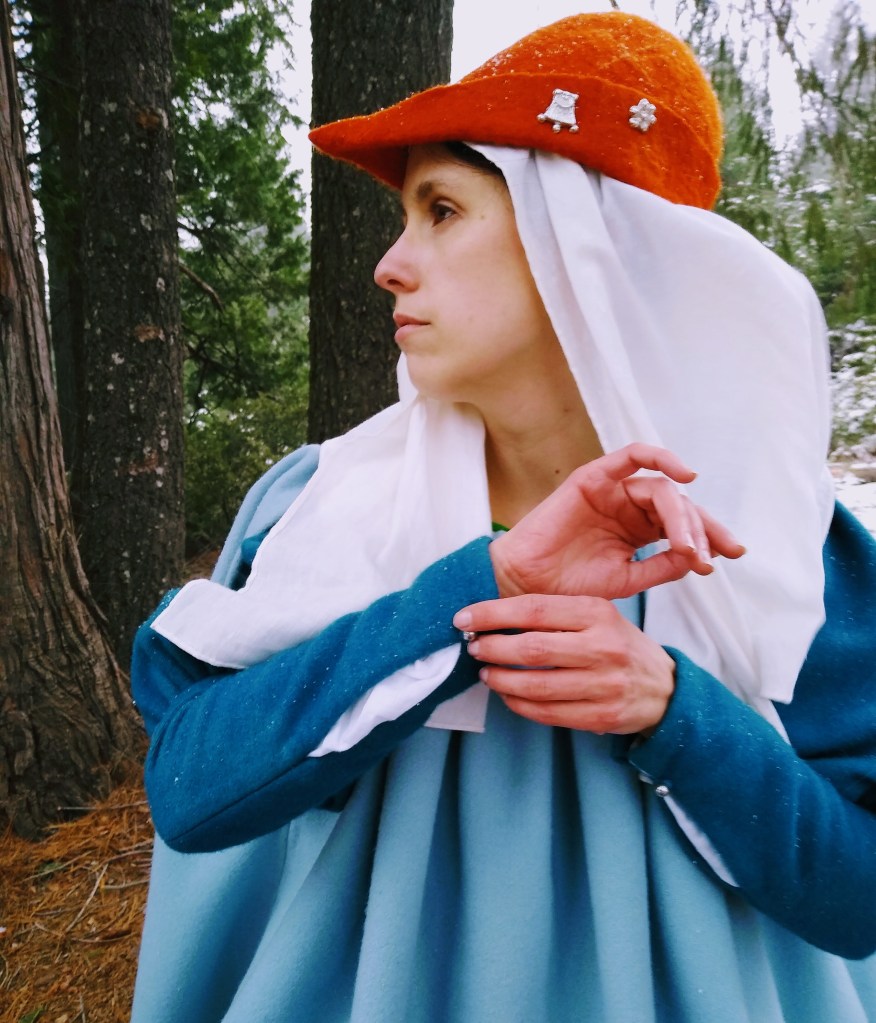
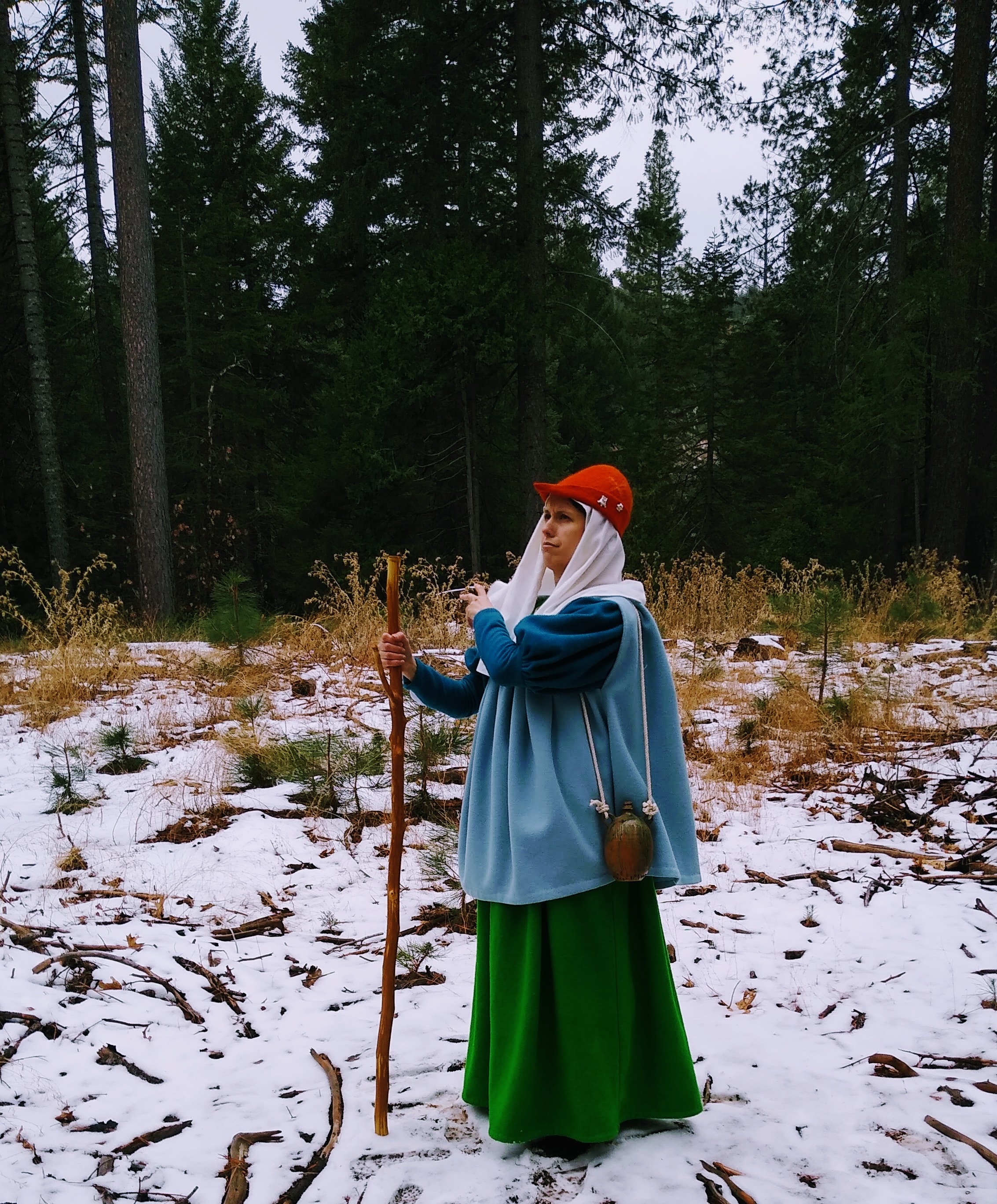
While definitely the simplest layer, this was the garment inspired the outfit. Our inspirational pilgrim wears a short mantle with arm slits. The length is practical and the arm slits allow for either use of arms or to turtle in. After looking at the inspiration and playing around, I realized that this was basically a skirt, the neck opening is even approximately my waist measure, although the length is a little shorter than my skirt. I used a coating weight wool. I haven’t found additional examples of short mantles in 15th century Tuscany, but it is certainly practical for travel. I found some earlier examples of short capelets and another fresco in the cycle showing working class woman wearing a shortened garment. In the real world I typically pair with a hood, but I have yet to find examples of hoods on women from my target time and place.

Hat
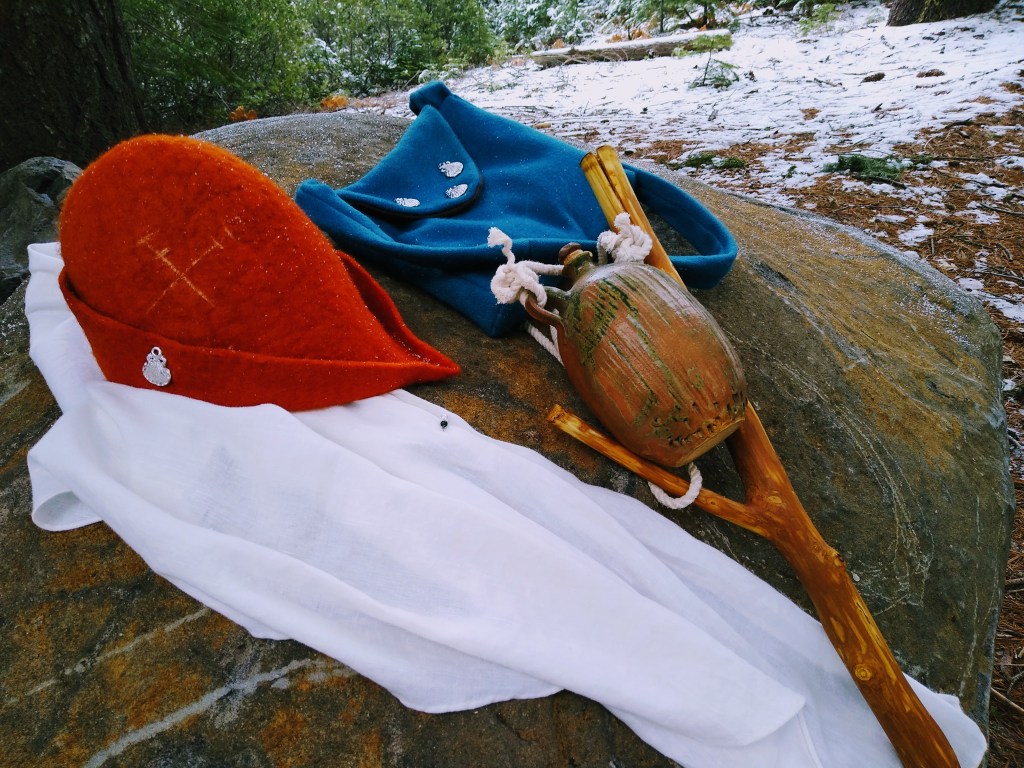
I wanted to create a felted hat, while the round hat on the inspiration is cute, as a person who typically wears glasses a bycocket seemed more practical. I noticed that there appears to have been a bycocket on one of the women in my favorite work by Piero della Francesca that is no longer present. I took the shape from another hat appearing in the same fresco cycle. The hat was wet felted from wool roving and dyed after making. I opted to add the chalk crossed pilgrim staffs based on the inspiration piece rather than creating a pewter version of them.
Badges
Pewter or lead badges are commonly seen on pilgrims. As I didn’t have a specific pilgrimage path in mind, I chose designs that struck my fancy and skill level. I tried to use the design and scale of the extant badges, but cast using sand rather than carved molds as they would have been done in period due to my own beginner skill level.
Badges
Pewter or lead badges are commonly seen on pilgrims. As I didn’t have a specific pilgrimage path in mind, I chose designs that struck my fancy and skill level. I do admit that the purse might not be pilgrimage related, possibly some sort of occupationally related badge, but I couldn’t resist. I tried to use the design and scale of the extant badges, but cast using sand rather than carved molds as they would have been done in period due to my own beginner skill level.
Snowy photos courtesy of Abigale Drake
References:
- Herald, J. (1981). Renaissance dress in Italy: 1400-1500. Bell et Hyman.
- The realm of venus – fashion and style in Renaissance Italy. The Realm Of Venus – Fashion and Style in Renaissance Italy. (n.d.). Retrieved December 29, 2021, from http://realmofvenus.renaissanceitaly.net/
 tellina makes